Salvio Digesto
Variationist Sociolinguist
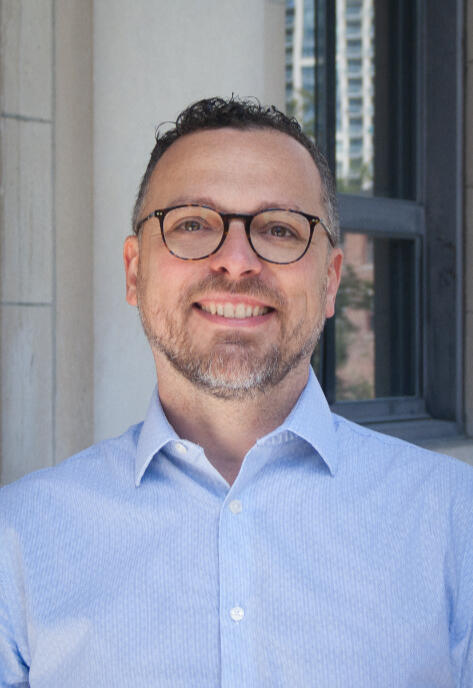
I am a variationist sociolinguist studying language use within its social context. I focus on issues such as morphosyntactic variation and change, minority languages, language contact, historical sociolinguistics, as well as the relationship between prescription, language prestige, and usage. My research applies sociolinguistic principles to the study of language variation and change, with a particular focus on Romance languages, especially French and Italian.In 2019, I graduated from the University of Ottawa where I obtained a doctorate in Linguistics. I am currently an Assistant Professor, Teaching Stream, in French Linguistics at the Department of French at Carleton University (Ottawa, Canada).
Academic Appointments
-
2024 - present, Assistant Professor, Teaching Stream, Department of French, Carleton University.
-
2022 - 2024, Assistant Professor, Department of French, Dalhousie University.
-
2021 - 2022, Adjunct Professor, Department of French, Carleton University.
-
2020 - 2022, Research Advisor, University of Ottawa.
-
2016 - 2020, Adjunct Professor, Department of Linguistics, University of Ottawa.
-
2011 - 2012, Adjunct Professor, Department of Languages, Université Paris 1 Panthéon-Sorbonne.
Education
-
PhD Linguistics, 2019, University fo Ottawa - Thesis: Verum a fontibus haurire. A Variationist Analysis of Subjunctive Variability Across Space and Time: from Contemporary Italian back to Vulgar Latin - Thesis supervisor: Shana Poplack.
-
MA Études Romanes, Linguistics and Translation, 2012, Université Paris-Sorbonne - Thesis: "Need a bag? Voulez-vous un sac?". Le code-switching à Montréal. Une réinterprétation urbaine ? - Thesis supervisor: Alessandra Stazzone.
-
BA/Licence Langues, littératures et civilisations étrangères, Minor: Français langue étrangère (FLE), 2010, Université Paris-Sorbonne.
-
Diplôme d'Université (D.U.) Langue et culture japonaise, 大学の学位 、日本語と日本文化, 2009, Université Paris 7 Diderot.
Certificates
-
Programming in Python, 2022, eCornell, Cornell University.
-
Concepteur d’examen CLES1 (Compétence en langue de l’enseignement supérieur). Niveau B1 du Cadre de référence commun européen, Université de Grenoble III (Université Stendhal).
Research
In my research, I draw on insights and questions from sociolinguistic theory and link those questions to empirical observations by integrating quantitative and statistical modeling into the study of language. I believe that integrating evidence from multiple sources can lead to a better understanding of the structure of language.
FRENCH AND RELATIVE CLAUSESIn 2023, I joined the international research project, the CAPES-PRINT Initiative (Brazil), which explores variation in relative clauses in Brazilian Portuguese (Rosane Berlinck, Unesp - Universidade Estadual Paulista), French (myself, Carleton University), and English (Stephen Levey, University of Ottawa).
PAN-ROMANCE PERSPECTIVEAnother important dimension of my research adopts a pan-Romance perspective. By comparing French, Italian, Portuguese, and, where relevant, Latin, I investigate how shared inherited structures and language-specific developments shed light on variation, change, and the social evaluation of linguistic forms across Romance languages
LANGUAGE CONTACTMy research interests include examining underlying mechanisms of language mixing. My goal is to investigate the outcomes of language contact, e.g. borrowing and code-swithing, in French-English and Italian-English/French bi-multilingual discourse.
FRENCH AS A SECOND AND FOREIGN LANGUAGEAn emerging area of my research concerns sociolinguistic variation in French as a second and foreign language. I am particularly interested in extending variationist sociolinguistic methods to the study of L2 speech in order to examine how learners acquire variable linguistic patterns and develop sociolinguistic competence.
DATA COLLECTIONAnother core project is related to data collection through sociolinguistic interviews. My goal is to build different benchmarks for the study of French and Italian among both monolingual and bilingual speakers, in order to investigate variation and change. I am currently collecting data on Acadian French spoken in Atlantic Canada.
Non-Standard Variation & Linguistic Ideology
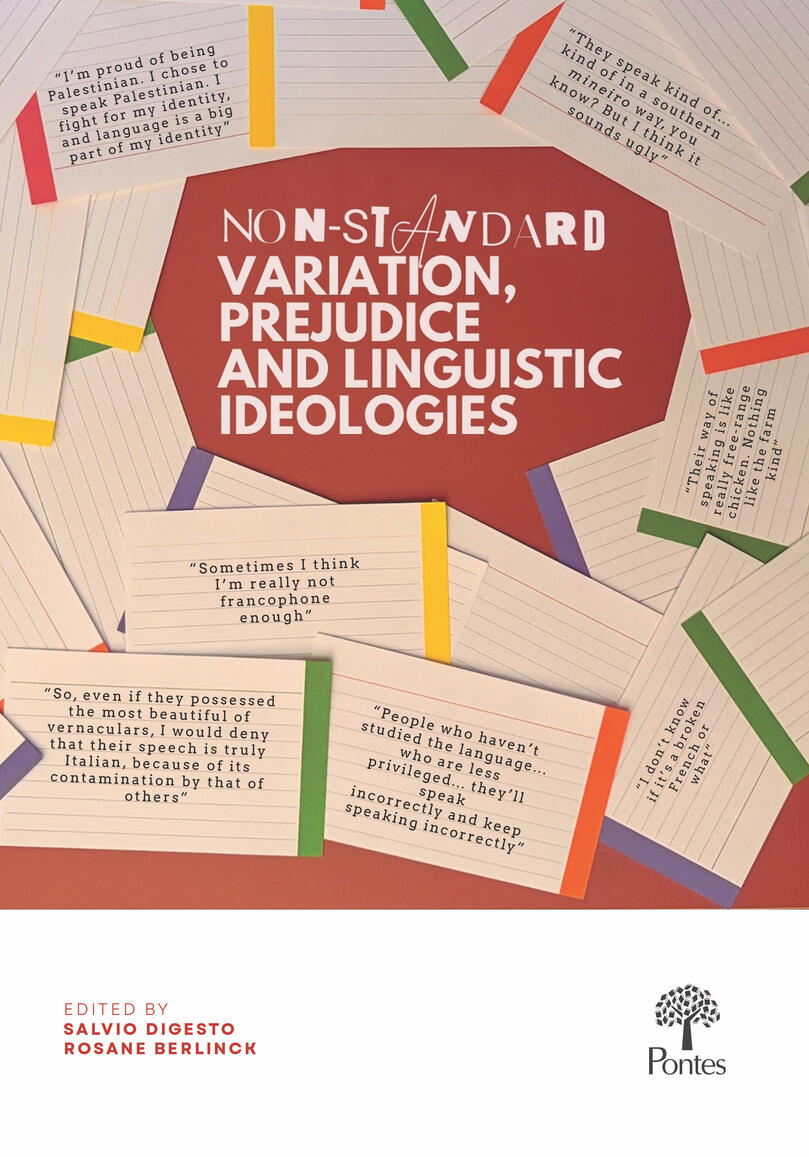
Forthcoming this Spring: Non-Standard Variation, Linguistic Prejudice and Ideologies, co-edited with Rosane de Andrade Berlinck (UNESP) and published by Pontes Editores. The volume explores the relationships between non-standard linguistic practices, language ideologies, and social evaluation in a variety of linguistic and sociocultural settings.
The publication of this volume was supported by the Vice-President Research & Innovation International Fund, Dalhousie University; the Society and Culture Research Fund – Publishing Support Program, Faculty of Arts and Social Sciences (FASS), Dalhousie University; and the Brazilian National Council for Scientific and Technological Development.A link to the open-access version of the book will follow soon.
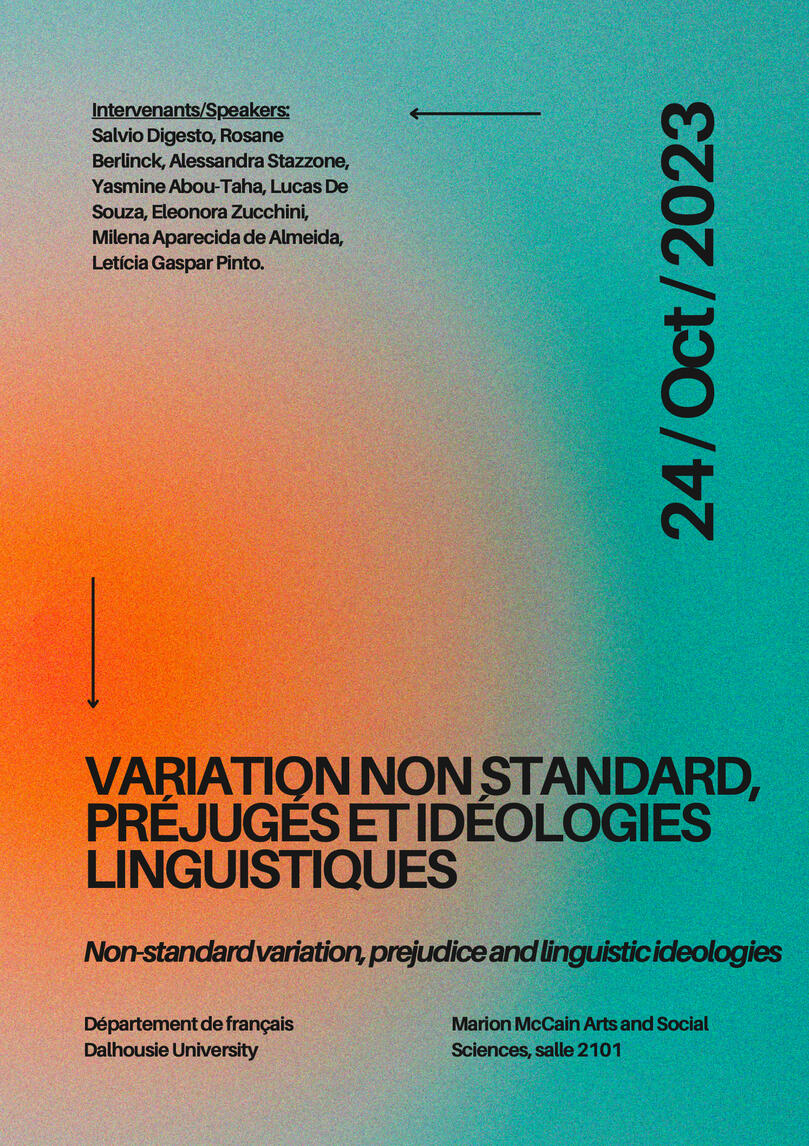
On October 24, 2023, together with my colleague Rosane Berlinck (Universidade Estadual Paulista, UNESP), I co-organized a workshop on non-standard linguistic variation, prejudice, and linguistic ideologies. The event was co-funded by the Office of the Vice-President Research and Innovation at Dalhousie University.Visit the event webpage and see the book of abstracts.
OTHER RESEARCH PROJECTS
Throughout the years, I have gained experience in data collection and handling, concordance software, and quantitative and statistical analyses by working on large-scale spontaneous speech corpora. These include monolingual Canadian French from the 19th to the 21st century, Italian, bilingual Canadian French/English, and British English. I have also participated in a number of research projects exploring morpho-syntactic and discourse-pragmatic features in Italian, French, and English, as well as language contact through a study of English compound words in French discourse.Research projects in which I have participated at the Sociolinguistics Laboratory, directed by Shana Poplack, at the University of Ottawa (2014-2019):🔖 Subjunctive variability in Romance.
🔖 Language ideology and prescription vs. usage of the Italian Subjunctive.
🔖 Comparative study of the variable expression of future temporal reference in French and Italian speech.
🔖 Conditionals in French: the alternation between indicative and conditional in si-clauses in 19th and 21st century Canadian French.
🔖 Complementizer deletion in British English in 7UP series: Change over a lifespan.
🔖 Language mixing: English compound words in French discourse.Research projects in collaboration with Stephen Levey, at the University of Ottawa:🔖 The acquisition of syntactic complexity in later childhood: a sociolinguistic study of English finite complement clauses.
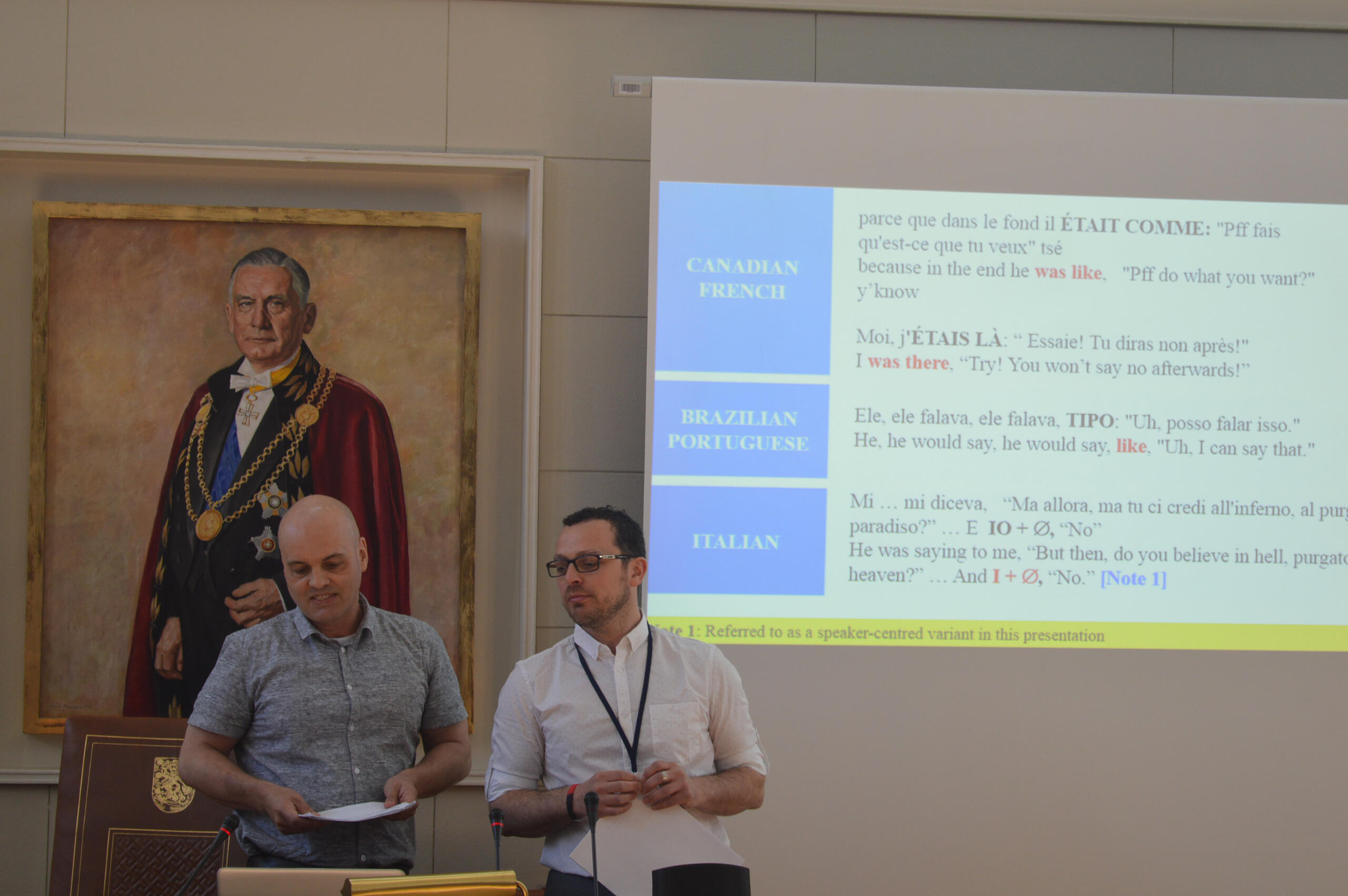
🔖 A Romance perspective on the quotative system.
🔖 Complementizer deletion in French discourse.
Publications
to appear
Digesto, S., & R. Berlinck (Eds.) Non-standard variation, prejudice and linguistic ideologies. Pontes Editores: São Paulo, Brazil
to appear
Digesto, S., & Berlinck, R. “Mapping Standardness in Relativization: a Case Study of Acadian French and Brazilian Portuguese Vernaculars”. In S. Digesto & R. Berlinck (Eds.), Non-standard variation, prejudice and linguistic ideologies. Pontes Editores
to appear
Stazzone, A., & Digesto, S. “La norme avant la Norme. Enjeux et structures de la formularité dans les écritures commerciales privées dans quelques textes toscans du XIIe siècle”. In F. Dumora, Peterson, E. Louviot, & A. Neyrinck (Eds.), La Formule au Moyen Âge V. Turnhout: Brepols.
2025
Digesto, S. “Governor-Driven Subjunctive Selection: A Variationist
Study from Latin to Romance”, Linguistic Typology at the Crossroads, Vol. 5, no 2, 224-88 - Link
2022
Levey, S., Kastronic, L., Digesto, S., & Chiasson, M. “Quotative Variation and Change in French, with Additional Insights from Brazilian Portuguese and Italian”. In E. Peterson, T. Hiltunen, & J. Kern (Eds.), Discourse-Pragmatic Variation and Change: Theory, Innovations, Contact. Cambridge University Press
2021
Digesto, S. “Lexicalization and Social Meaning of the Italian Subjunctive”, Cadernos De Linguística, Vol. 2, no. 3, p. e609
2021
Digesto, S. “Overt manifestations of language contact in the discourse of Italian Canadians”, Blog article, Speaking Of Which.
2021
Digesto, S., & Poplack, S. “Le français canadien, un français comme les autres”. France Forum, 65, 93–94.
2018
Poplack, S., Torres Cacoullos, R., Dion, N., de Andrade Berlinck, R., Digesto, S., Lacasse, D., & Steuck, J. “Variation and grammaticalization in Romance: A cross-linguistic study of the subjunctive”. In W. Ayres-Bennett & J. Carruthers (Eds.), Manuals in Linguistics: Romance Sociolinguistics. Mouton de Gruyter
Conferences & Guest Lectures
2025
Future time reference in spoken Italian: a variationist study. Massimo Cerruti and Salvio Digesto. International Conference on Language Variation in Europe (ICLaVE) 13. University of Lausanne and the University of Bern. June 29–July 2, 2026. - Conference Program
2026
Bridging Typology and Variation: Relativization, Standardness, and Ideology in Acadian French and Brazilian Portuguese. Salvio Digesto and Rosane Berlinck. SLE 2026, 59th Annual Meeting of the Societas Linguistica Europaea. 2026.
2026
Language Variation and Change: Principles, Methods, and Evidence (Invited lecture). Graduate Seminar, PhD Program Dialettologia, sociolinguistica e linguistica dell’italiano [Italian dialectology, sociolinguistics and linguistics]. Università di Torino, Turin, Italy. February 13, 2026.
2026
Variation pragmatico-discursive en français laurentien et en français acadien (Invited lecture). Course: Sociolinguistique, Prof. Émilie Urbain. January 29, 2026. Department of French, University of Ottawa, Ottawa, Canada.
2025
Anatomie d’un article savant en linguistique (Invited lecture). Course: Méthodologie de la recherche, Prof. Christine Duff. November 19, 2025. Department of French, University of Ottawa, Ottawa, Canada.
2025
Relativização no Português Brasileiro e no Francês Acadiano: Uma Perspectiva Sociolinguística Comparativa sobre Prescrição e Uso / Relativization in Brazilian Portuguese and Acadian French: A Comparative Sociolinguistic Perspective on Prescription and Use. With Rosane Berlinck (UNESP). Conference: Sociolinguística(S): variação e interfaces. October, 2025. Brazil
2025
Predire il presente e il futuro: analizzare la variazione linguistica in italiano con metodi statistici. With Chiara Paolini (UK Leuven). Conference: LVIII Congresso internazionale di studi della Società di Linguistica Italiana. Workshop 2
Metodi di analisi statistica della variazione linguistica nel dominio italo-romanzo. September, 2025. Italy - Workshop Program
2024
Linguistic Variation and Hidden Patterns: A Variationist Approach to Subjunctive Mood Selection. Invited speaker. October, 28, 2024. Department of Linguistics, KU Leuven, Belgium
2024
Cartographie sociolinguistique de la société médiévale dans le Ludus Scacchorum : une analyse des représentations sociales et linguistiques des pièces nobles et populaires. International conference : Divertir, éduquer et corriger : pratiques du jeu en Europe, du Moyen Âge à la première Modernité (XIIe-XVIe s.). October 9-11, 2024. Université catholique de Louvain, Belgium - Conference Program
2024
La norme avant la Norme. Enjeux et structures de la formularité dans les écritures commerciales privées des XIIème-XVIIème siècles. With Alessandra Stazzone (Paris-Sorbonne). International conference on stylistic formulas in Medieval culture, Formule au Moyen Âge. June 18, 19 and 20, 2024. Université de Reims Champagne-Ardenne, France - Conference Program
2023
Cerner la variation syntaxique non standard. Le cas des propositions relatives en français acadien et en portugais brésilien. With Rosane Berlinck (UNESP). Workshop, Non-Standard Variation, Prejudice And Linguistic Ideologies. October 24, 2023. Dalhousie University
2023
Variation and typology in Romance: a cross-linguistic study of subjunctive selection in spontaneous speech. With Shana Poplack, Rena Torres Cacoullos, Nathalie Dion, Rosane de Andrade Berlinck, Dora Lacasse & Jonathan Steuck. International conference on typology and sociolinguistic methods, Naturally occurring data in and beyond linguistic typology. May 18-19, 2023. Università di Bologna, Italy - Conference Program
2023
Typology And Variation of Subjunctive Mood. On Shared (Probabilistic) Constraints. International conference on typology and sociolinguistic methods, Naturally occurring data in and beyond linguistic typology. May 18-19, 2023. Università di Bologna, Italy Conference Program
2023
Variation et changement linguistiques au sein et au-delà du français canadien : communautés, contact et apprentissage de la langue seconde. Invited speaker. March 7, 2023. Department of French, Acadia University
2022
Variation et changement discursifs en français canadien. Le cas des marqueurs d’introduction du discours rapporté. Invited speaker, French Lecture Series. November 25, 2022. Dalhousie University
2020
What the Italian subjunctive “actually” means. Linguistweets. ABRALIN - Brazilian Linguistics Association. December 5
2020
Manipulating Corpus Data with Kontext. Invited Speaker. Faculdade de Ciências e Letras, SoLAr Sociolinguistics Research Group, Universidade Estadual Paulista – UNESP, São Paulo, Brazil. October 19 and 20
2019
Assessing language contact in a minority context in Canada: The Case of Ontarian French. Invited Speaker. Course LIN 2760 Bilingualism. Prof. Stephen Levey. Fall 2019. University of Ottawa. Ottawa, Canada
2018
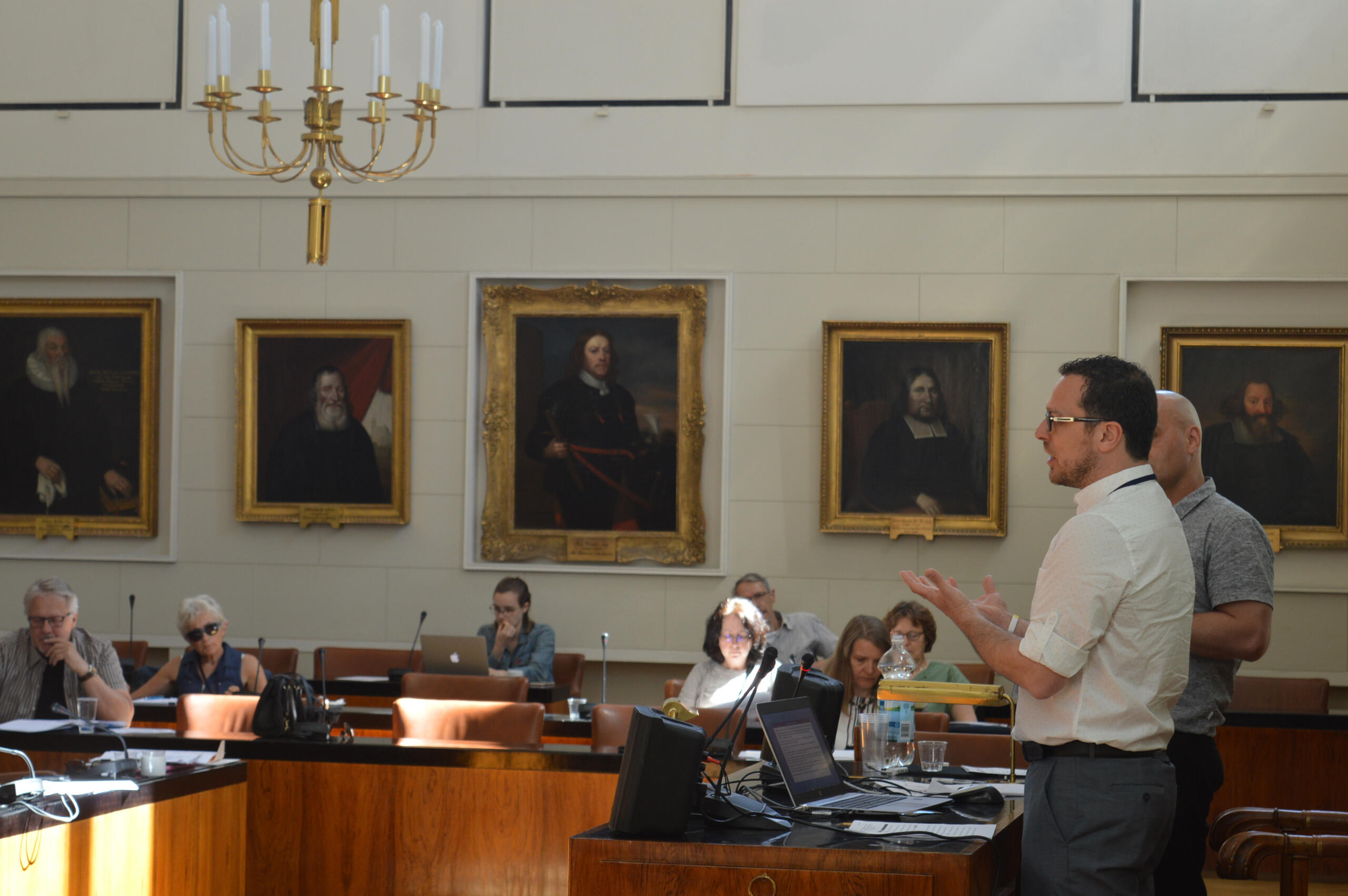
Putting the Romance back into reported speech: Evidence from Quebec French, Acadian French, Brazilian Portuguese and Italian. DiPVaC 4. 28-30 May. University of Helsinki. Helsinki, Finland. With Stephen Levey, Mélissa Chiasson-Léger, Ariane Dei Tos Cardenuto & Sarah Lefebvre. May 29
2018
Dealing with variability in loanword integration. Presenter and Discussion Leader. Graduate Seminar LIN 7342 Bilingualism, Prof. Shana Poplack. University of Ottawa, Ottawa, Canada. February 6
2016
Unveiling the Future: the case of Italian. OCLU 2016. University of Ottawa. Ottawa, Canada. November 26. (Plenary Session)
2016
Unveiling the Future: the case of Italian. Invited Speaker. Graduate Research Seminar in Sociolinguistics, Prof. Shana Poplack. Fall 2016. University of Ottawa. Ottawa, Canada
2016
Meaningful variation? A multi-language study of the Romance subjunctive. Sociolinguistics Symposium (SS) 21. University of Murcia. Murcia, Spain. With Shana Poplack, Rena Torres Cacoullos, Nathalie Dion, Rosane de Andrade Berlinck, Dora Lacasse & Jonathan Steuck. June 17
2016
Patterns of futurity: A variationist study of future temporal reference in Italian. Change and Variation in Canada (CVC) 9. University of Ottawa. Ottawa, Canada. May 8
2016
Identical or fraternal twins? The Synthetic Future in French and Italian. Linguistics Symposium on Romance Languages (LSRL) 46. Stony Brook University (SUNY). New York, USA. With Shana Poplack. (Accepted but withdrawn)
2016
Tracking grammaticalization across Romance: Evidence from the subjunctive. Linguistics Symposium on Romance Languages (LSRL) 46. Stony Brook University (SUNY). New York, USA. With Shana Poplack, Rena Torres Cacoullos, Nathalie Dion, Rosane de Andrade Berlinck, Dora Lacasse & Jonathan Steuck. March 31
2015
Strong and Weak Claims. A Semantic Account of Counterfactuals in Italian. Invited Speaker. Doctoral Seminar, Prof. Éric Mathieu. Fall 2015. University of Ottawa. Ottawa, Canada
2015
Using variability to measure grammaticalization: A pan-Romance study of the subjunctive. New Ways of Analysing Variation (NWAV) 44. University of Toronto. Toronto, Canada. With Shana Poplack, Rena Torres Cacoullos, Nathalie Dion, Rosane de Andrade Berlinck, Dora Lacasse & Jonathan Steuck. October 23
2015
A pan-Romance perspective on subjunctive variability. Canadian Linguistic Association (CLA) 2015. University of Ottawa. Ottawa, Canada. With Shana Poplack, Rosane de Andrade Berlinck & Nathalie Dion. May 31
2015
Le Futur à Présent. Une étude variationniste de la référence temporelle du futur en italien parlé. Journées de Linguistique (JDL) 2015. Université Laval. Québec, Canada. March 6
2013
Langues et société à l'ère de la mondialisation. Le cas de Montréal. Valeur(s) et responsabilité(s) face à la globalisation. Université Paris-Est Créteil et Université Paris-Sorbonne. Paris, France. Novembre 22
2013
Lieux et enjeux du code-switching à Montréal. La frontière en soi. Université de Montréal. Montréal, Canada. May 2
Dissertation
Title
Verum a fontibus haurire. A Variationist Analysis of Subjunctive Variability Across Space and Time: from Contemporary Italian back to Vulgar Latin
Abstract
This dissertation investigates the use of the subjunctive in completive clauses governed by verbs in Italian, both synchronically and diachronically, and in Vulgar Latin. By making use of the tools provided by the Variationist Sociolinguistic framework (Labov 1972, 1994), the current study sheds light on the underlying conditioning on variability using actual usage and speech-surrogate data. Contemporary actual speech data comes from LIP (De Mauro et al. 1993) and C-ORAL-ROM (Cresti & Moneglia 2005) corpora, providing spontaneous discourse in casual and careful speech as well as sub-sample divisions representative of geographical variation. In order to measure any changes in the underlying conditioning on subjunctive selection, a diachronic benchmark is established: a corpus of speech-like surrogates of 16th to 20th century Italian, COHI (Corpus of Historical Italian), and a corpus of Vulgar Latin (Cena Trimalchionis, from the Satyricon by Petronius). The subjunctives were extracted in adherence to the principle of accountability (Labov 1972), using the method developed by Poplack (1992): every complement clause governed by a matrix verb (governor) that triggered the subjunctive at least once was included. This method enables us to circumvent the issue of the lack of consensus in the literature on exactly which contexts, i.e. verbs and/or meanings, should trigger the subjunctive in discourse. This issue surfaces as well from the meta-linguistic analysis of a compendium of 58 Italian grammars and treaties (CSGI, Collezione Storica di Grammatiche Italiane), constructed for the purpose of this research. A series of linguistic and extra-linguistic factors proposed by formal and prescriptive literature are operationalized and tested against the corpora of both Italian and Vulgar Latin, in order to ascertain the nature of variability in discourse: i.e. whether the use of the subjunctive is semantically motivated, productive in speech or undergoing desemanticization and lexicalization. Despite widespread assumption of a change that occurred after the political and the subsequent linguistic unification of Italy, i.e. that the subjunctive has lost ground in favour of the indicative when it was supposedly used categorically in the past, quantitative and statistical evidence shows that subjunctive selection is largely determined by lexical identity of the governor as well as embedded suppletive forms of essere, and that this pattern has been operative at least since the 16th century. On a more socio-linguistic aspect, this study confirms the linguistic prestige that the subjunctive has acquired in contemporary speech, being selected with a wider range of infrequent and singleton governors by highly educated speakers. Also, the highly lexicalized pattern on variability was found to be largely shared amongst the four main urban centres of Florence, Milan, Rome, and Naples, thus countering the assumption of divergent linguistic behaviour between northern and southern varieties of Italian. The study also shows that despite the significant time span targeted, no evidence of desemanticization has been found. Likewise, the variationist analysis on the Vulgar Latin subjunctive shows that subjunctive choice was already largely determined by, and restricted, to a few governors, identified as ‘volitive’ and ‘emotive’ matrices. These governors remained strong predictors for the selection of the subjunctive in Italian as well, suggesting that this lexical pattern has been transferred and consistently retained in the daughter language
Download
Comprehensive Papers & Unpublished manuscripts
✏️ 1st Comprehensive Paper in Variationist Sociolinguistics. L’évolution de l’expression de la référence temporelle du futur en italien : une étude synchronique et diachronique.✏️ 2nd Comprehensive Paper in Formal Semantics/Pragmatics. Strong and Weak Claims. A semantic account of counterfactuals in Italian.✏️ I think Ø something is missing here: A variationist study of complementizer deletion in Italian discourse. Seminar: Urban Dialectology II. University of Ottawa, Winter 2014.✏️ When is a black horse a black-horse? English compound words in French discourse. Seminar: Bilingualism. University of Ottawa, Winter 2015.✏️ T’es comme : « Ahh ! ». C’est le fun, tu sais. Réflexions variationnistes autour de être comme en français québécois. Seminar: Urban Dialectology I. University of Ottawa, Fall 2014.✏️ Assessing the counterfactual implicature in an experimental setting with R. Seminar: Experimental Pragmatics. University of Ottawa, Winter 2015.
Teaching
Department of French, Carleton University
Winter 2026
FREN 4060 : Projet de recherche supervisé
FREN 2451 : Sémantique formelle du français, upper-undergraduate course - syllabus
FREN 2401 : Introduction à la linguistique II (morphology, syntax, semantics)
Winter 2025
FREN 4060 : Projet de recherche supervisé
FREN 3414 : Sociolinguistique du français, upper-undergraduate course - syllabus
FREN 2401 : Introduction à la linguistique II
Department of French, Dalhousie University
Winter 2024
FREN 5295 : Second Language Teaching and Acquisition, graduate seminar
FREN 4002 : History of French, Modern Period, upper-undergraduate course
FREN 1008 : Basic French II
Fall 2023
FREN 3017 : Differential Linguistics (Fall), upper-undergraduate course
FREN 2022 : Spoken French
FREN 1047 : Français intermédiaire I
Spring 2023
FREN 5998 : Independent Research on Language Contact, graduate course
FREN 5998 : Independent Research in Sociolinguistics, graduate course
Winter 2023
FREN 3000 : Advanced Oral French Workshop, upper-undergraduate course
FREN 2021 : Language and Culture, Le français : origines, diffusion et francophonie
FREN 1048 : Français intermédiaire II
Fall 2022
FREN 5295 : Second Language Teaching and Acquisition, graduate seminar
FREN 4014 : Language and Society, upper-undergraduate course
FREN 1047 : Français intermédiaire I
Department of French, Carleton University
Winter 2022
FREN 2401 : Introduction à la linguistique française II
Fall 2021
FREN 2401 : Introduction à la linguistique française I
Winter 2021
FREN 3412 : Morphologie, upper-undergraduate course
Department of Linguistics, University of Ottawa
Fall 2020
LIN3742 : Sociolinguistique, upper-undergraduate course
Winter 2020
LIN3315 : Introduction to Semantics, upper-undergraduate course
Fall 2019
LIN3715 : Introduction à la sémantique, upper-undergraduate course
LIN2700 : Les langues dans le monde, upper-undergraduate course
LIN1700 : Qu’est-ce que le langage ?
Summer 2019
Introduction à la linguistique – Summer program for francophone students
Winter 2019
LIN2700 : Les langues dans le monde, upper-undergraduate course
Winter 2019
LIN1740 : Langue et société
Fall 2018
LIN3742 : Sociolinguistique, upper-undergraduate course
LIN1700 : Qu’est-ce que le langage ?
Summer 2018
Introduction à la linguistique – Summer program for francophone students
Winter 2018
LIN3742 : Sociolinguistique, upper-undergraduate course
Fall 2017
LIN3715 : Introduction à la sémantique, upper-undergraduate course
Fall 2016
LIN3742 : Sociolinguistique, upper-undergraduate course
Department of Languages, Université Paris 1 Panthéon-Sorbonne
Winter 2013
Italian as a Second Language 1, 2 & 4, undergraduate and graduate level courses
Fall 2012
Italian as a Second Language 1 & 2, undergraduate and graduate level courses
Invited Professor, Università di Bologna
Summer 2023
Language variation and linguistic structure. Invited professor at the Spring School On Language Variation. May 16, 2023. Università di Bologna, Italy
Contact
Department of French
Carleton University
Office: 1625, Dunton Tower
1125 Colonel By Dr
Ottawa, ON K1S 5B6
CanadaT 613.520.2600 x2184
Feel free to send an email directly at salvio.digesto@carleton.ca or fill in the contact form:
KONTEXT is now Exempla The original KONTEXT concordance application has been substantially redesigned and expanded with new tools for corpus exploration and analysis. Beginning with Version 2.0, the application is now called Exempla. If you have previously used KONTEXT, you are in the right place: Exempla builds on the original application while introducing a redesigned interface and a substantially expanded set of analytical features.
Exempla is a corpus concordance and analysis application designed for the exploration of text files and linguistic corpora. It was developed particularly with transcriptions of spoken language in mind, but it can be used with a broad range of textual corpora and supports direct import of plain-text (.txt) and Microsoft Word (.docx) files. Exempla allows you to search for words, phrases, and sequences of characters and examine every occurrence together with its preceding and following context. Concordance results identify the source text, location of the occurrence, and speaker, where speaker information is available. Beyond concordancing, Exempla provides tools for exploring the structure and composition of a corpus, including word and sequence frequencies, speaker and text distributions, corpus statistics, and a clipboard for collecting and exporting selected examples. Scopes allow you to define subsets of the corpus based on particular texts and/or speakers and carry out analyses on precisely the data you want to examine. Searches can target complete words or character sequences and can be restricted according to their position within a word, for example 'begins with', 'ends with', or 'contains'. This makes it possible to investigate anything from individual lexical items and recurring sequences to morphological patterns and other character-based phenomena. Exempla uses UTF-8 encoding and can therefore be used with corpora in many languages. Exempla is 100% FREE. Exempla can import plain-text (.txt) and Microsoft Word (.docx) files directly. In most cases, no manual preprocessing is required. During import, Exempla automatically processes the source while preserving the information needed to associate tokens with their correct line and position. For transcriptions of spoken language, keep the following conventions in mind:
Import your transcription directly as a plain-text (.txt) or Microsoft Word (.docx) file. Exempla can process the document automatically while preserving the information needed to keep tokens associated with their correct line and position;
Text between square brackets is interpreted as a speaker code, for example [02], [023], or [1] in the excerpt below;
Text between parentheses is interpreted as a comment and is excluded from concordance counts, for example (laughing) or (rire).
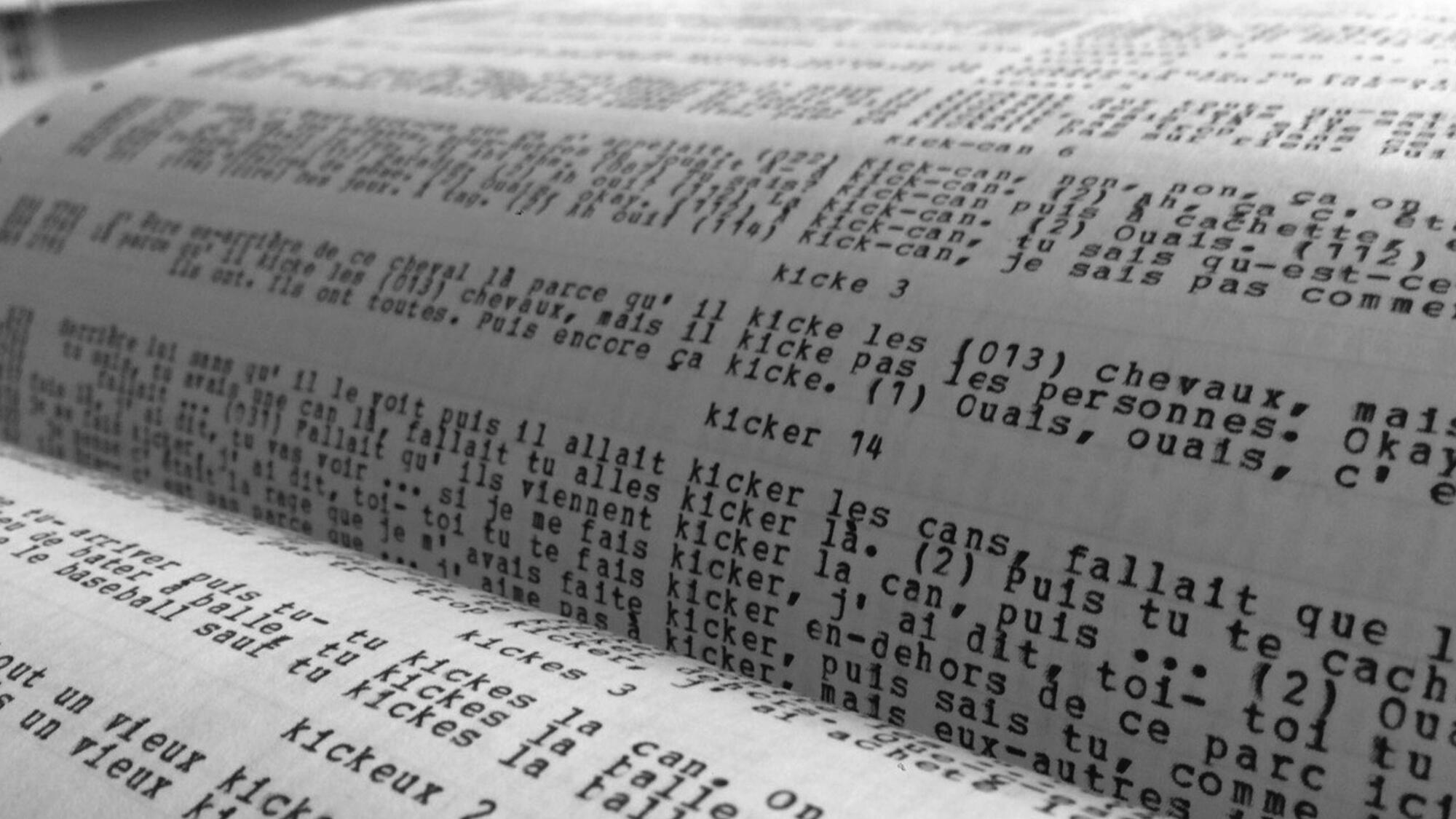
Example of a transcription of spontaneous speech (adapted from Poplack 1989: 446. The care and handling of a mega-corpus: The Ottawa-Hull French project):
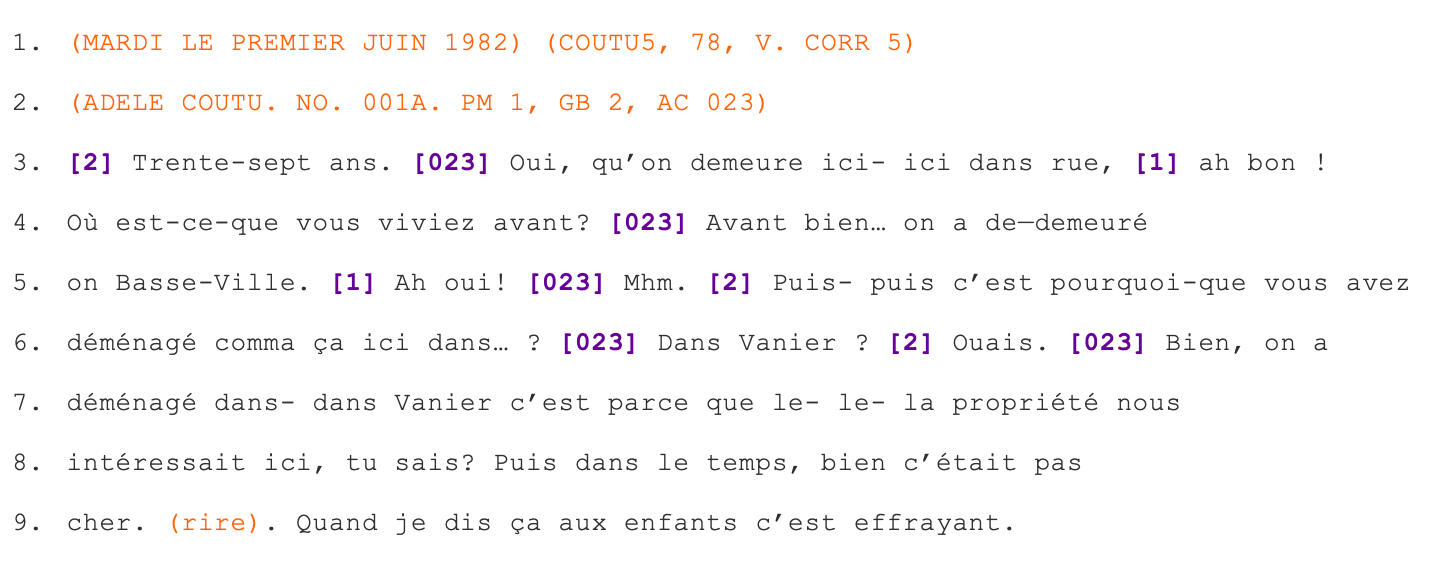
Once imported, Exempla handles the necessary processing automatically while preserving the structure required for concordance searches and corpus analysis.
Exempla 2.0 is now available. Try it out, and any feedback would be greatly appreciated!Download the version compatible with your computer's operating system (macOS or Windows):
Exempla 2.0 for
Windows
Exempla 2.0 for
macOS
To cite Exempla, please use the following reference:
Digesto, S. (2026). Exempla (Version 2.0) [Computer software]. Carleton University. https://www.digesto.ca/exempla
Contact
Coming soonÉchos is a knowledge-mobilization project designed to bring research on language to a wider public. The platform will feature journal-style articles, podcasts, and selected student work, with a particular focus on French, linguistic variation, language ideologies, and the place of language in society.
Thank you for your message!Your message has been sent successfully. I will get back to you as soon as possible.Salvio
-

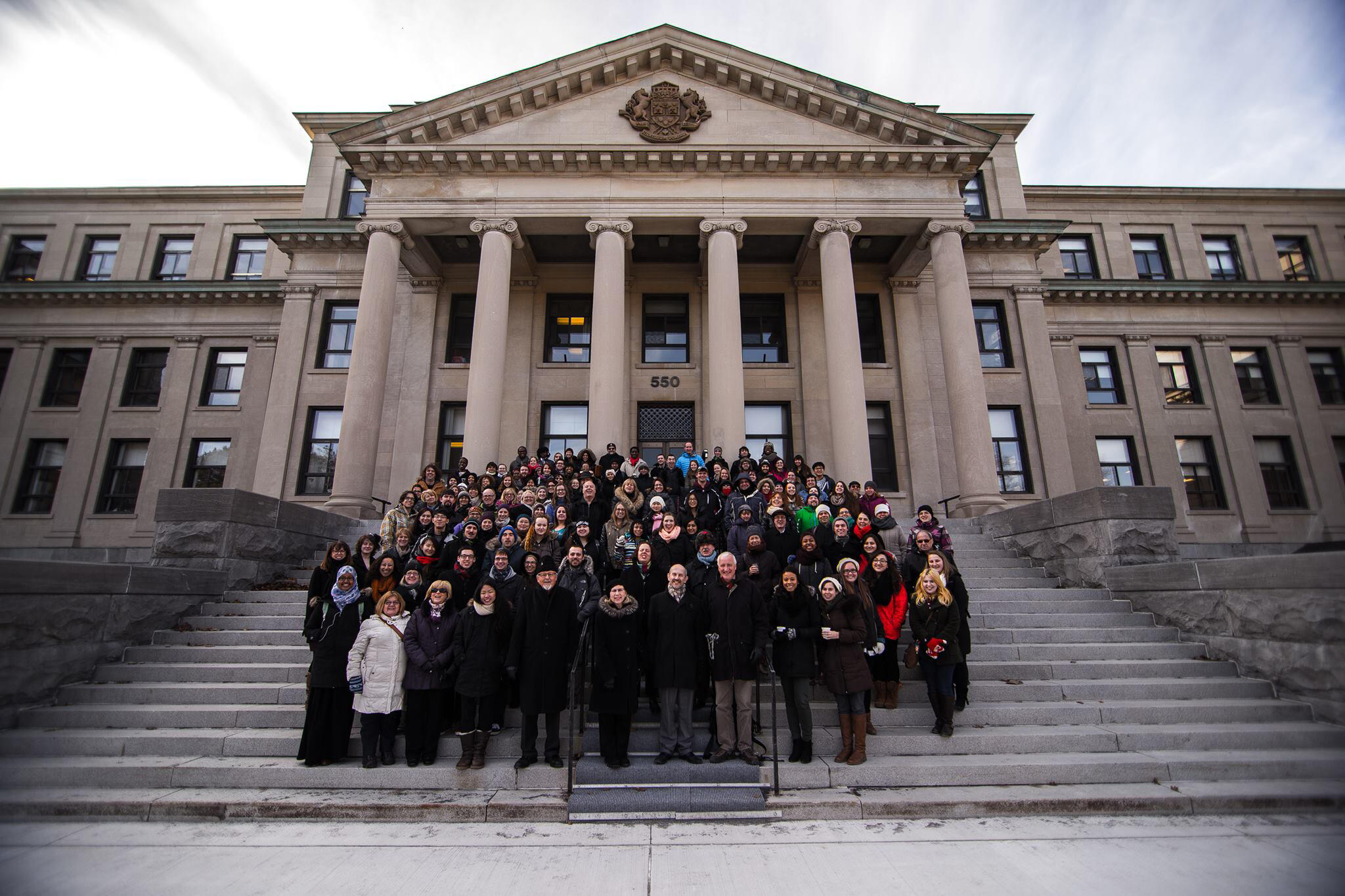
125th Anniversary, Faculty of Arts, University of Ottawa
-

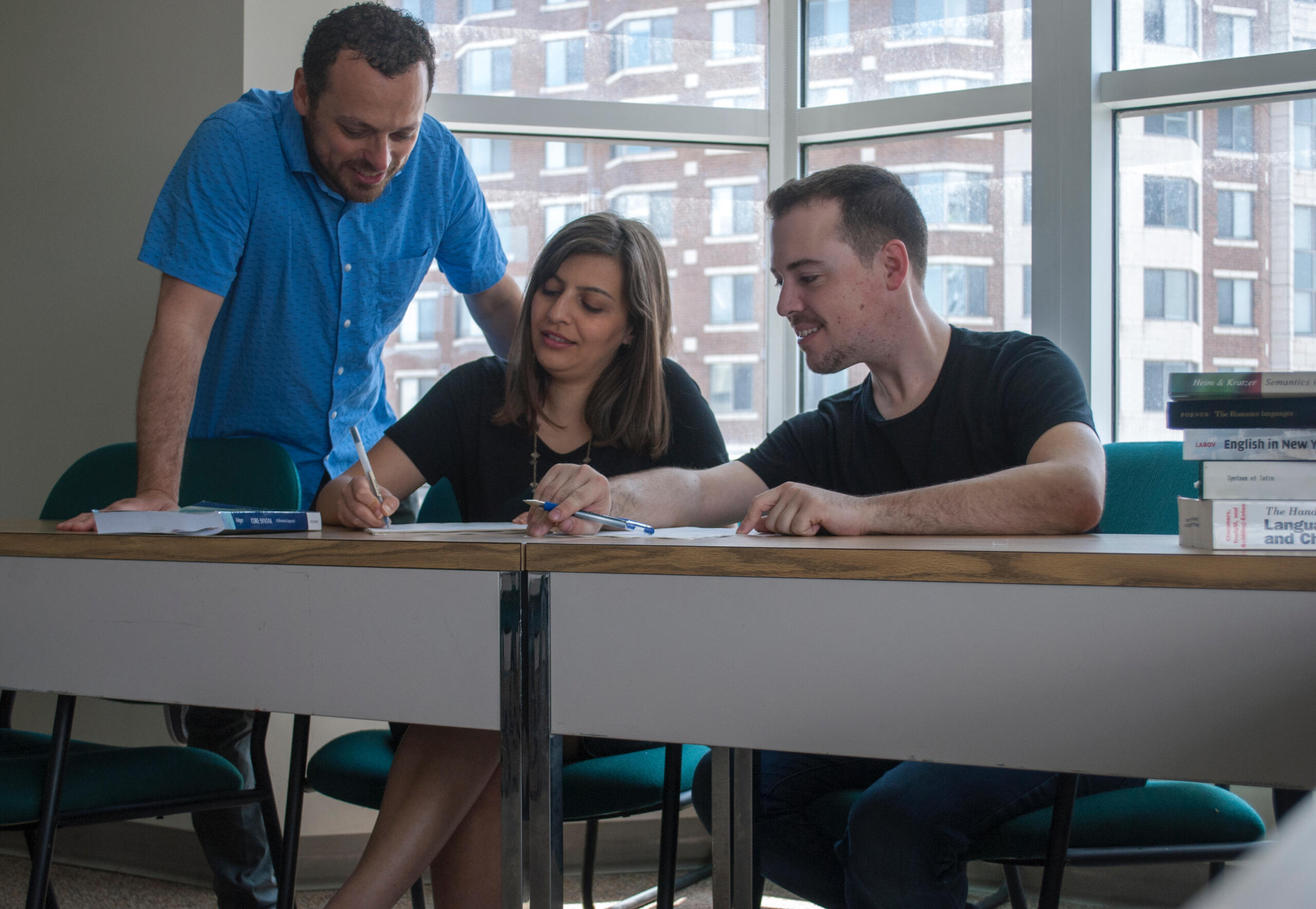
Syntax/Semantics with Myriam Dali & Basile Roussel, University of Ottawa
-

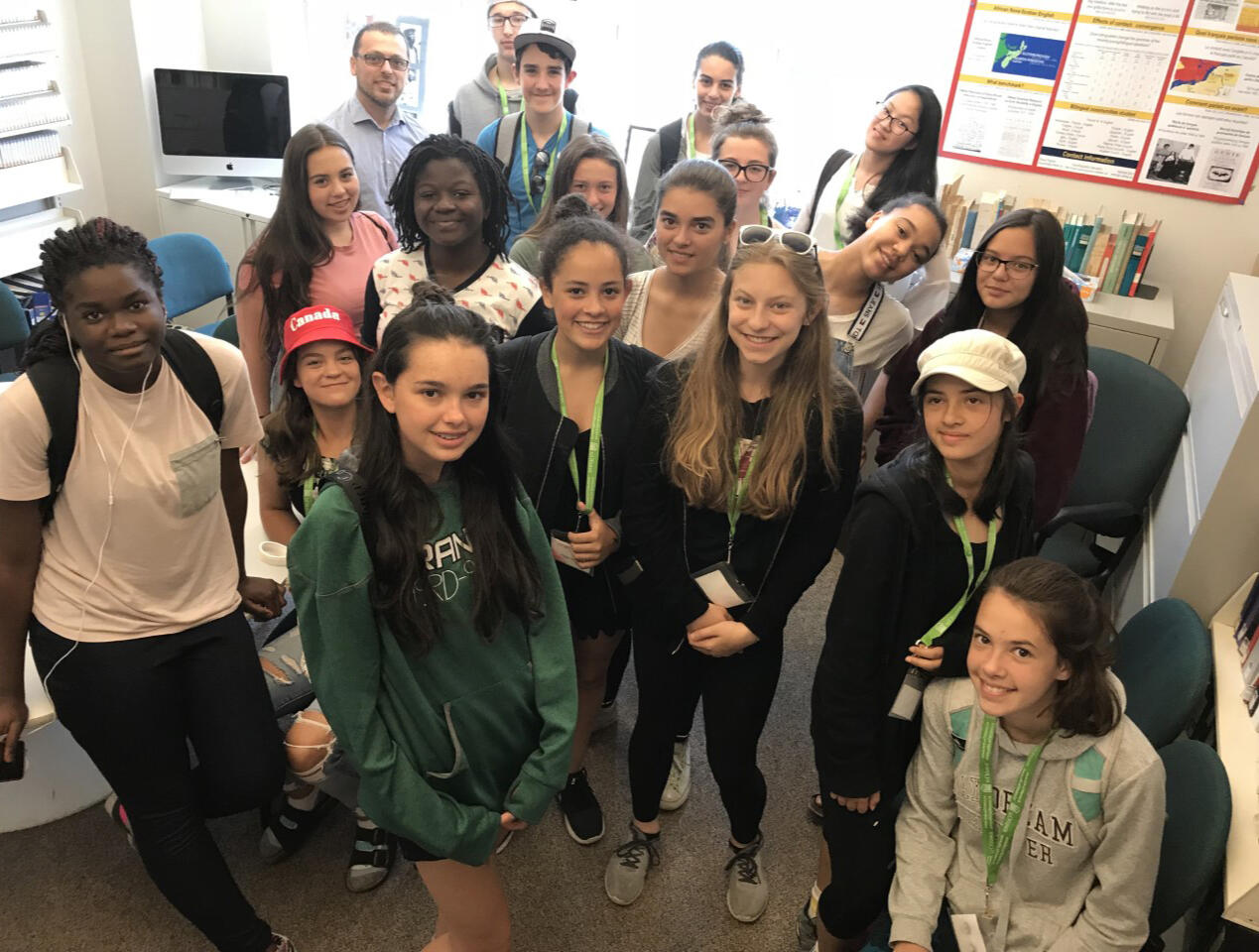
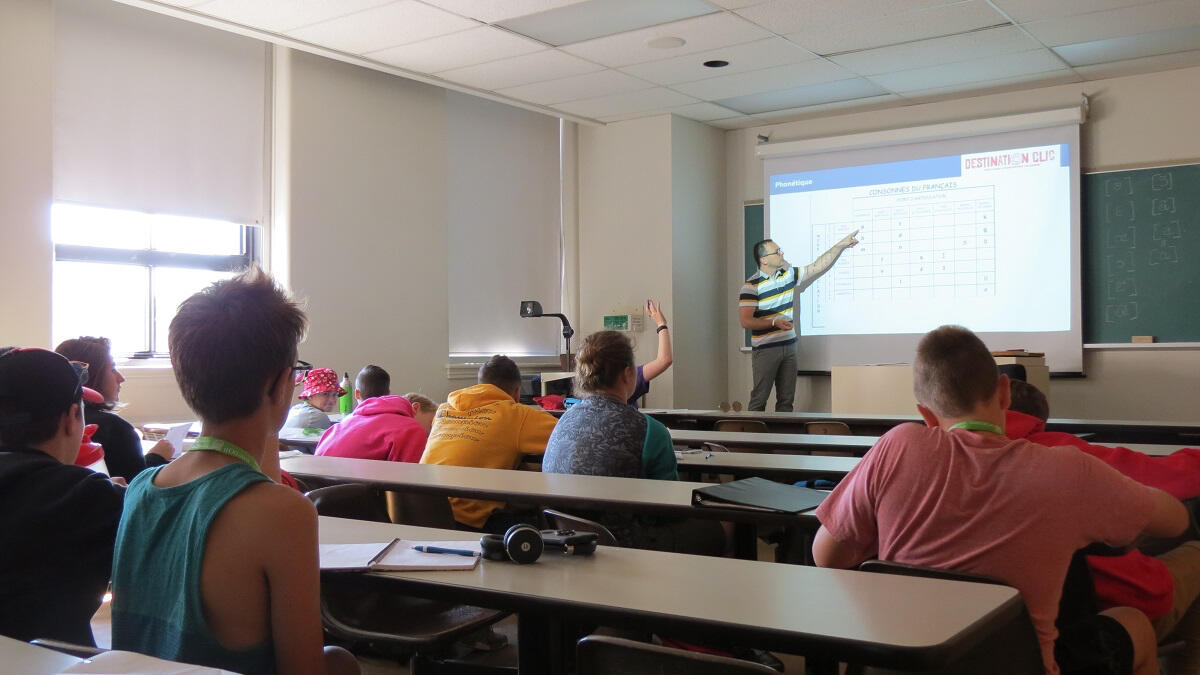
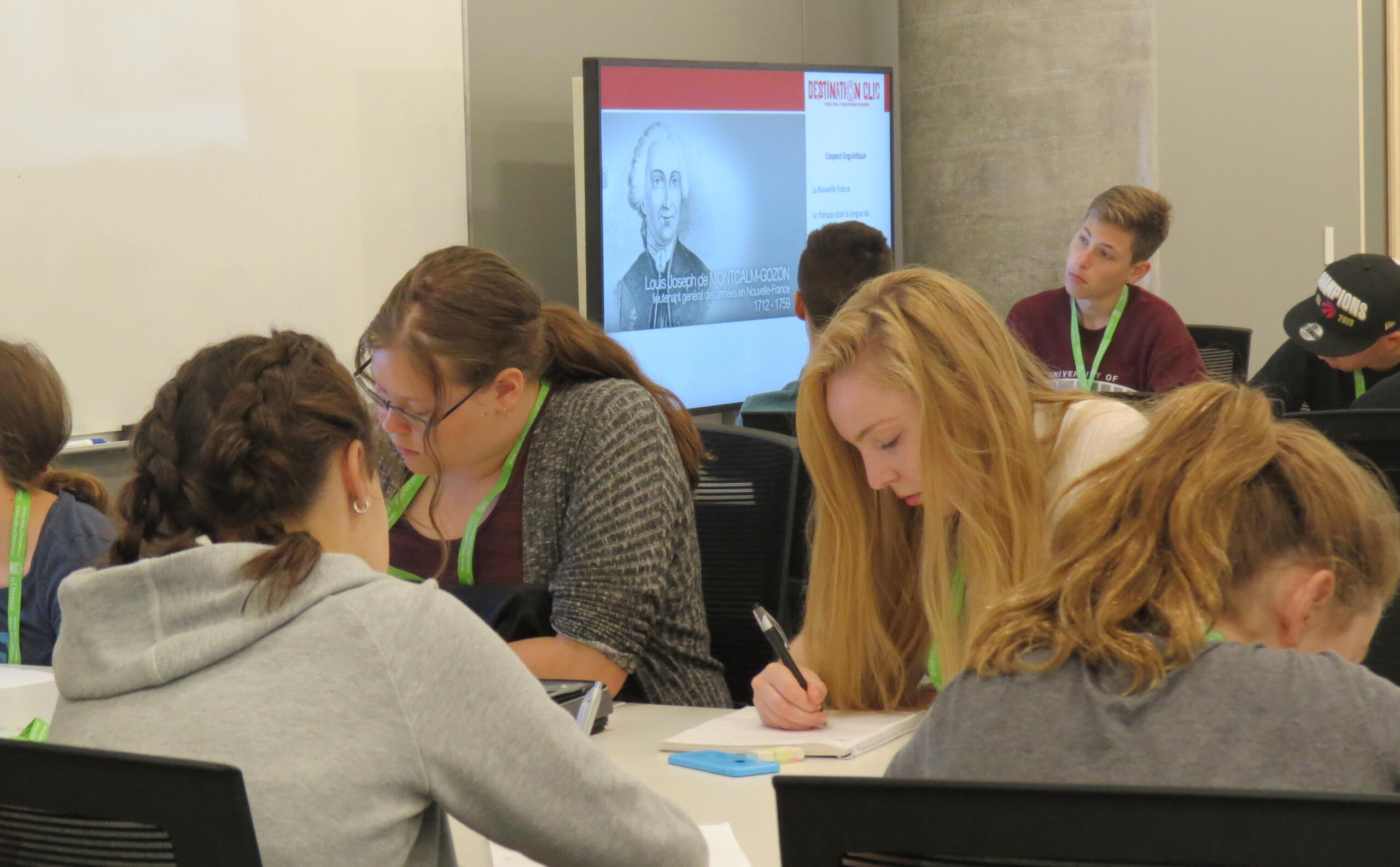
Summer Program "Destination CLIC 2018" for francophone students in Grades 8 and 9, University of Ottawa
-

Summer Program "Destination CLIC 2018" for francophone students in Grades 8 and 9, University of Ottawa
-

Summer Program "Destination CLIC 2018" for francophone students in Grades 8 and 9, University of Ottawa
-

DiPVaC 4 Helsinki, with Stephen Levey
-

DiPVaC 4 Helsinki, with Stephen Levey
-

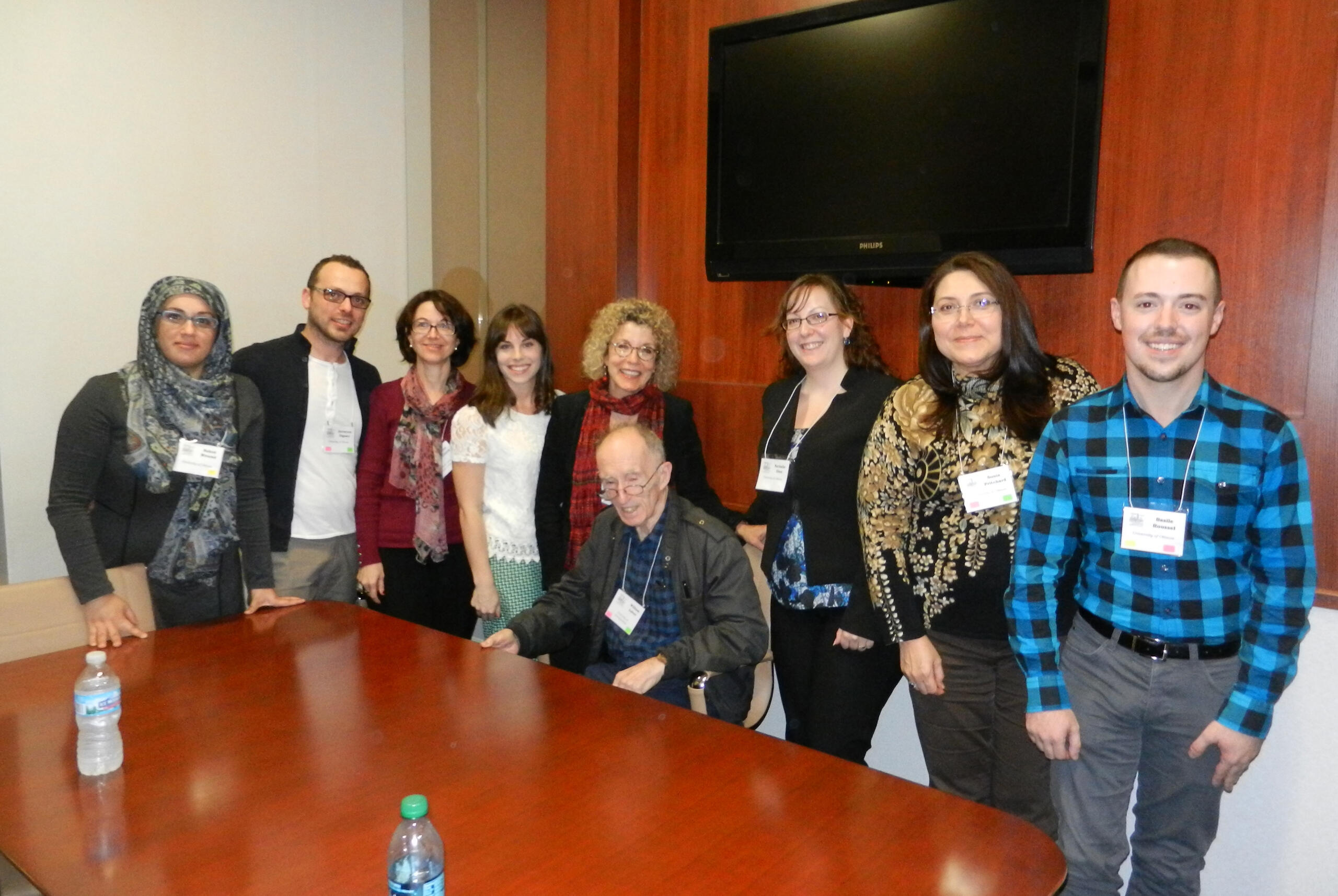
NWAV 43 CHICAGO, with William Labov, Shana Poplack, Rosane Berlinck, and other colleagues from the Sociolab
-

NWAV 43 CHICAGO, with Rena Torres-Cacoullos, Shana Poplack, Rosane Berlinck, Hélène Blondeau, Sali Tagliamonte, Nath Dion, James Walker, among others
-

26th Japanese Speech Contest, 2015, Embassy of Japan, Ottawa
-

PhD Convocation, University of Ottawa, with Shana Poplack
-

NWAV 44 Toronto, selfie with Shana Poplack and Laura Kastronic
-

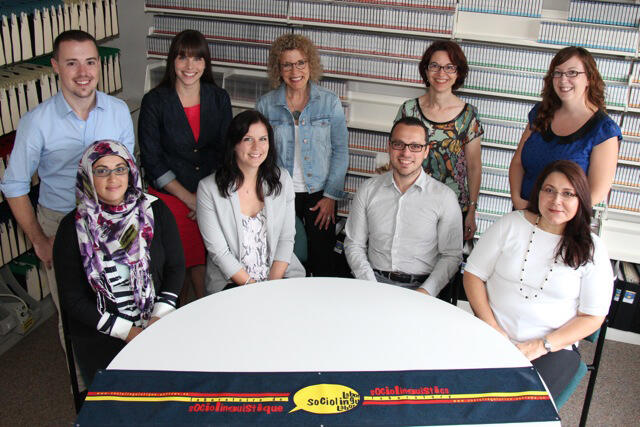
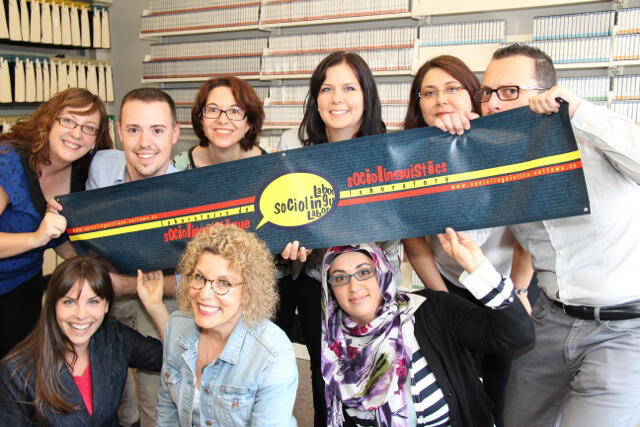
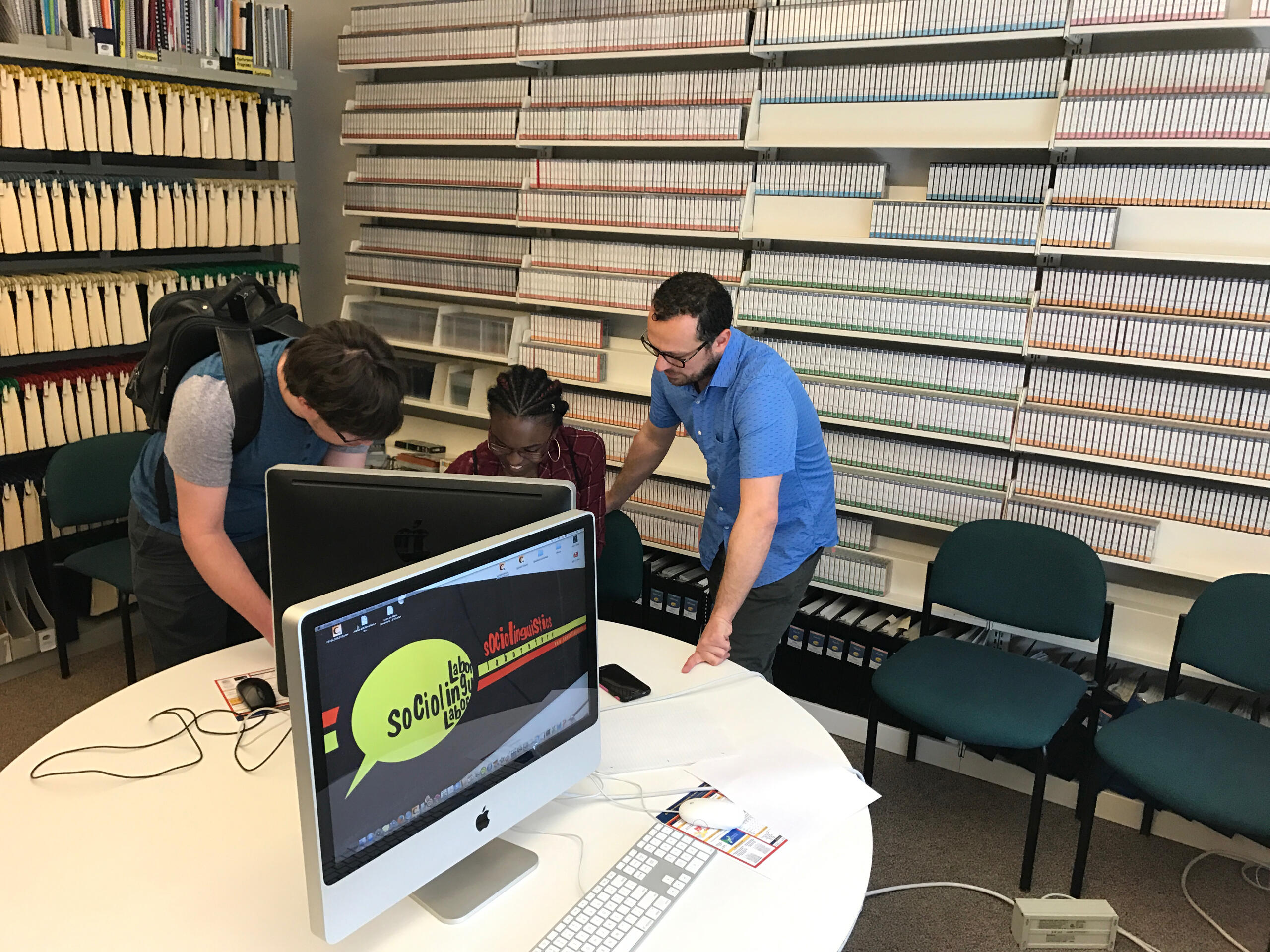
Sociolinguistics Laboratory, University of Ottawa
-

Sociolinguistics Laboratory, University of Ottawa
-

Workshop "Language and Society", University of Ottawa